Open the live demo, pick a point distribution, and hit run. The first pass clusters your points with the hand-rolled Rust k-means from this post, compiled to WebAssembly; the second is a pure-JavaScript k-means on the same data and the same seed, timed beside it with performance.now() on your machine. That gap is what this whole post measures. At n=1,000, a full elbow sweep (load the CSV, fit every k from 1 to K, write results) takes pure-Python NumPy 0.43 s and scikit-learn 1.57 s; my hand-rolled Rust binary does it in 0.029 s, roughly 15x over NumPy and 54x over the industrial, BLAS-backed scikit-learn. That 15x is the small-n, single-run figure; the paired median across the n=1k cells lands at 14.5x. Then I gave everyone the same initialization, swept out to a quarter-million points, and watched the 15x shrink to 3.5x, with one corner of the grid flipping outright.
There is only one computation in this whole investigation: Lloyd’s k-means loop, assign then update, on a matched k-means++ grid. I implemented it four times, and each implementation is best read as a single diff from the one before it. Speed, parallelism, memory, accuracy, and the model’s hard limits are not five separate experiments. They are five lenses on one shared substrate. Every interesting result is what changes, and what doesn’t, as you walk the diffs.
- Pure-Python NumPy - about 150 lines, the baseline most pipelines start from.
- Hand-rolled serial Rust - explicit loops, no interpreter, no per-operation allocations.
- Rayon-parallel Rust - the same Rust binary, run with
--parallel --threads 0. - scikit-learn at
n_init=1- the industrial standard, given a single start like everyone else.
The parallel build is a full contestant, not a footnote. It runs on the same grid and reports the same metrics, so its thread bonus shows up as a measured number rather than a promise.
Four ways at a glance (648 runs, Apple M4 Max, all implementations on identical k-means++ init):
| Implementation | Median wall time | Speedup vs Python | Median RSS / 1k rows | Median ARI |
|---|---|---|---|---|
| Pure-Python NumPy | 0.806 s | 1.0x (baseline) | 7.41 MB | 1.00 |
| Serial Rust | 0.201 s | 4.5x | 0.61 MB | 1.00 |
| Parallel Rust (Rayon) | 0.197 s | 5.1x | 0.73 MB | 1.00 |
scikit-learn (n_init=1) | 1.843 s | 0.44x | 12.63 MB | 1.00 |
Speed decays with size (15x to 3.5x for serial Rust); Rayon tops out at 1.32x over serial; the memory ranking never flips; matched init ties the quality.
Speedup column, definitions made explicit. The two Rust figures are medians of paired per-dataset ratios (Python time over Rust time, one ratio per dataset). scikit-learn’s 0.44x is instead the ratio of overall median wall times (0.806 / 1.843), because its standing against Python reverses with size (0.27x at n=1k, 1.80x at n=256k), so no single paired median describes it cleanly.
One computation, four ways
Everything below sits on the same substrate, so it is worth pinning down exactly what that substrate is before I start swapping out execution engines under it.
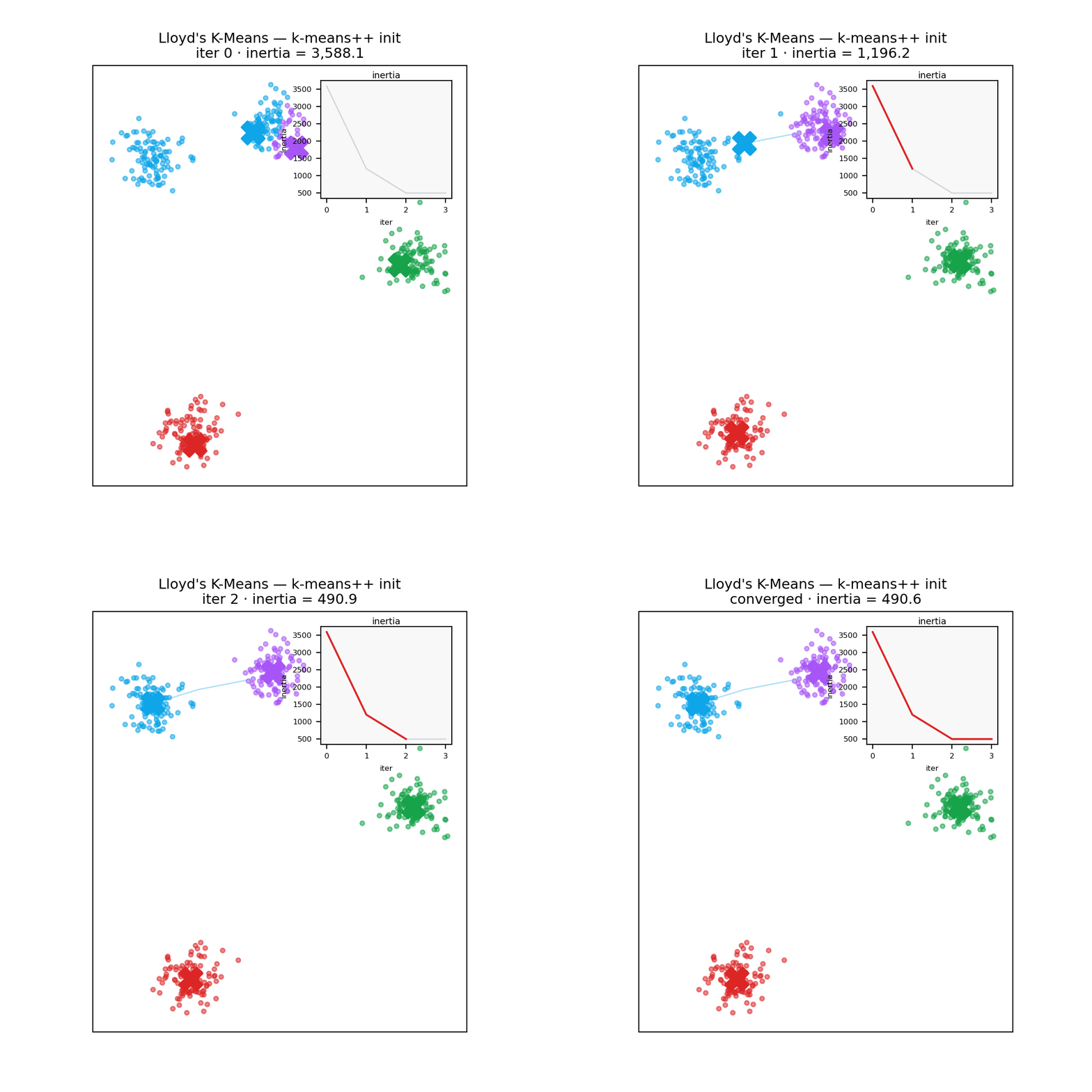
The algorithm predates most of modern computing. Stuart Lloyd worked it out at Bell Labs in 1957 as a quantization scheme for pulse-code modulation, though the memo wasn’t formally published until 1982, and MacQueen coined the name “k-means” in 1967. A biologist sequencing ten thousand single cells, or an astronomer plotting a million stars by color and brightness, reaches for exactly this to find the groups in unlabeled data. What everyone runs today, NumPy and Rust and scikit-learn alike, is still Lloyd’s loop:
- Assign each point to its closest centroid.
- Update each centroid to the mean of its assigned points.
Both steps minimize the same objective, the within-cluster sum of squares:
\[J = \sum_{i=1}^{n} \lVert x_i - \mu_{c_i} \rVert^2\]The assignment step minimizes $J$ over the labels $c_i$ with the centroids held fixed, and the update step minimizes it over the centroids $\mu_j$ with the labels held fixed. Neither step can increase $J$, so the loop converges to a local optimum. If you’ve trained anything with EM or alternating least squares, this is the same coordinate-descent shape. (The companion site’s algorithms page works through it as alternating minimization in full.)
The cost per iteration is $O(nkd)$: every point against every centroid across every dimension, dominated by the distance computation. And that distance computation hides a matrix multiply, which is the single fact that explains why the four implementations diverge the way they do. Stack the data into $X$ (shape $n \times d$) and the $k$ centroids into a matrix $M$ (shape $k \times d$), one centroid per row. Expanding the square,
\[\lVert x_i - \mu_j \rVert^2 = \lVert x_i \rVert^2 - 2\, x_i \cdot \mu_j + \lVert \mu_j \rVert^2,\]the cross term $x_i \cdot \mu_j$ over all pairs at once is the $n \times k$ matrix $X M^\top$, formed by contracting over the $d$ feature dimensions. The $O(nkd)$ work lives in that contraction. The $-2$ scales that block, and the two norm terms (one cheap pass over the points, one over the centroids) wrap around it to assemble the full distance matrix. Hold onto that decomposition. It is the seam where the four implementations come apart: NumPy materializes the whole distance block, Rust refuses to, and scikit-learn hands the contraction to BLAS.
How they fill it in is the only thing that differs. The NumPy version loops over centroids, filling one column of the distance matrix at a time with np.linalg.norm(X - centroids[k], axis=1). Serial Rust runs explicit loops over its own data and never builds the matrix at all. The parallel build is byte-for-byte the same binary with Rayon splitting the assignment step across worker threads. scikit-learn routes the dominant cross term through a BLAS GEMM. Same arithmetic, four execution profiles. The rest of the post walks those four profiles one diff at a time and watches what each lens reveals.
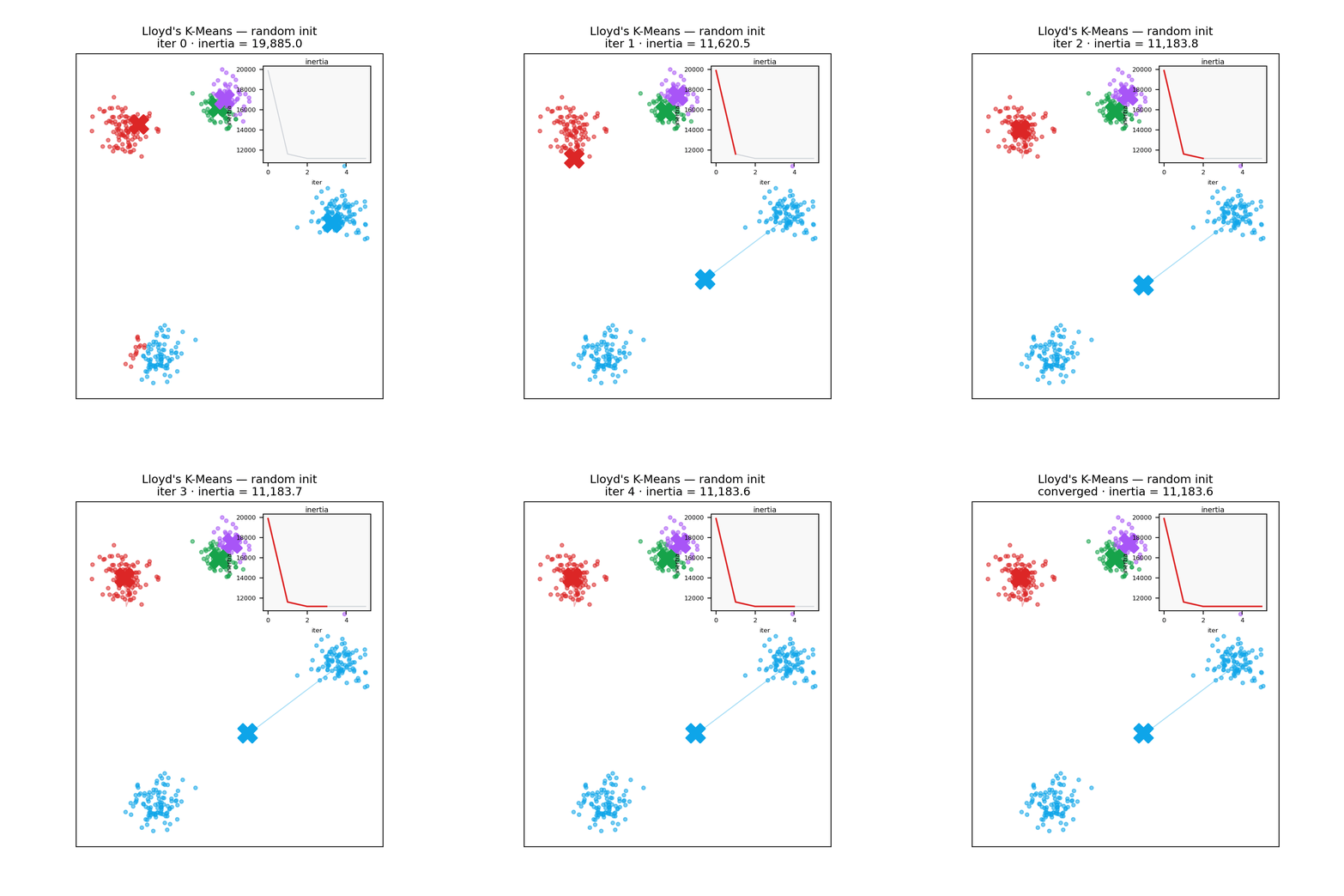
The grid the substrate runs on
One end-to-end CLI run per configuration: load CSV, fit k = 1..K, write CSV, exit. I time the whole subprocess instead of an in-process fit, because the subprocess is what a pipeline actually pays for. The grid is 9 sizes (1k to 256k, doubling) × 3 feature counts (2/8/32) × 2 cluster budgets (k_max 8 or 32) × 3 repeats, on synthetic Gaussian blobs. That gives 162 dataset cells × 4 implementations = 648 runs. One fairness control carries the most weight, and it is the thread that ties the whole post together. Every implementation uses k-means++ initialization, and scikit-learn runs at n_init=1, a single start like everyone else. This is a rerun of an earlier experiment that didn’t control init. That control changes one headline result, which I’ll get to in the accuracy section. Keep the matched init in mind as I walk the diffs; it is doing quiet work in every panel.
Metrics are subprocess wall time, sampled peak RSS (polled every 10 ms, so an estimate that can undercount brief spikes rather than a kernel max), and ARI/NMI against the ground-truth blob labels.
Diff one: NumPy to serial Rust (speed)
The first diff strips the interpreter out of Lloyd’s loop and writes the same arithmetic as explicit Rust loops. No per-operation allocations, no dispatch overhead, no materialized distance matrix. That is the entire change, and across the full sweep it buys a median 4.5x over pure-Python NumPy.
That 4.5x is a median of paired ratios: each of the 162 datasets gets one Python-time-over-Rust-time ratio, and the median is taken across those. The mean of the same ratios is about 6.6x, pulled up by the small-n cells where Rust shines, and the ratio of overall median runtimes is 4.02x. I lead with the median for the same reason you report p50 latency rather than the average: it describes the configuration you’ll actually hit, not the one that flatters the rewrite.
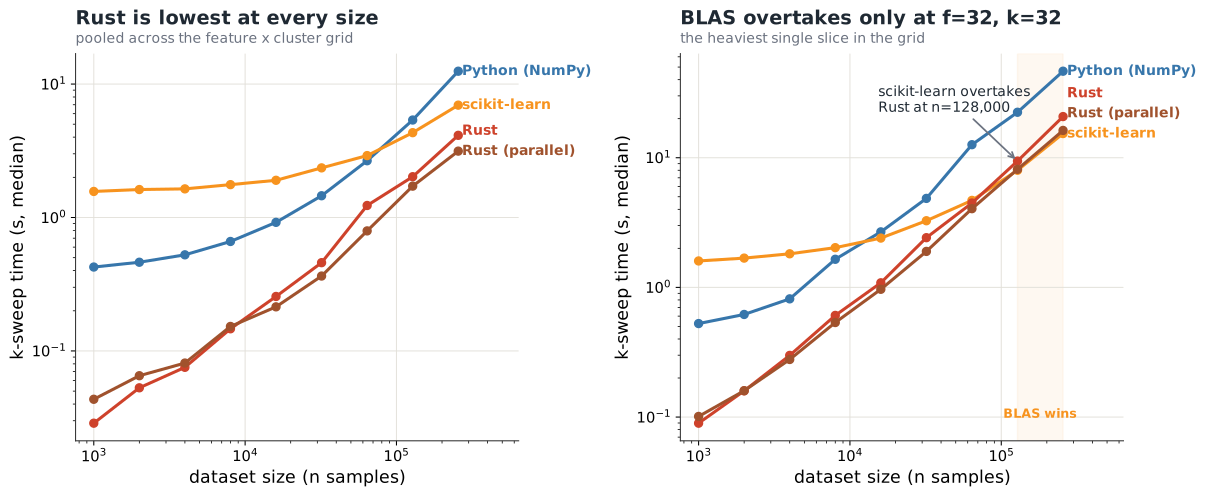
The single number hides a curve, and the curve is the real story. Pooled across the grid, Rust runs from 0.029 s at n=1k to 4.13 s at n=256k. Its fitted slope is 0.902 (R² 0.993), close to linear and slightly under it, about what you’d expect from naive $O(nkd)$ loops picking up some cache pressure. NumPy’s slope is 0.599 (R² 0.911). These are descriptive fits over size-medians, not clean algorithmic exponents, which the R² values reflect. The point is the ordering, and the ordering holds across the grid: the more fixed overhead an implementation carries, the less it notices additional rows, and that is why the Rust lead decays as n climbs.
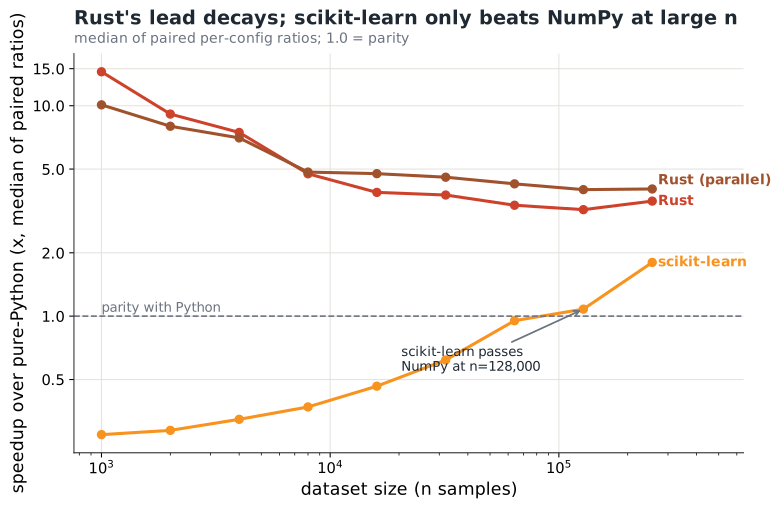
n_init=1, none of scikit-learn's small-n drag is restart cost.That decaying Rust curve is the answer to “how much faster is the rewrite,” and the answer is: it depends entirely on where you sit. 14.5x at n=1k, about 3.5x at n=256k, never below 3x. Whenever someone quotes a single speedup number for a rewrite, they have picked one point off this curve and called it the verdict.
Diff two: serial Rust to scikit-learn (the BLAS corner)
The second diff is not an optimization I made; it is the comparison that exposes the limit of my loops. Hand the dominant cross term to BLAS instead of writing it out by hand, and one corner of the grid flips.
scikit-learn’s slope is a near-flat 0.249 (R² 0.831), the flattest of the four, because most of its cost is fixed and the per-row work is the cheapest of anyone’s. That flatness is what eventually catches Rust. My first, uncontrolled run had scikit-learn “overtaking Rust at n=128k,” full stop; the rerun sharpens it into something narrower and more honest. Pooled over the grid, Rust never loses to scikit-learn at the median, not even at 256k. scikit-learn is faster in exactly 4 of 54 grid cells, and all four have k_max=32 and n ≥ 128k. The crossover barely cares about feature count: two of those four cells are at f=2, the skinniest data in the grid. What tips the balance is rows times clusters, the $n \times k$ face of the distance computation, more than the full GEMM volume. In the heaviest slice (f=32, k=32), scikit-learn finishes in 8.0 s against serial Rust’s 9.4 s at 128k, and 15.4 s against 20.8 s at 256k. At the light end Rust beats scikit-learn by 6x to 65x with no crossover in sight.
The single heaviest workload (256k rows, 32 features, k=32) is the clearest snapshot of all four ways at once: scikit-learn 15.36 s, parallel Rust 16.23 s, serial Rust 20.76 s, pure-Python NumPy 46.46 s. scikit-learn runs the same Lloyd iteration as everyone else; it simply hands the dominant term to a GEMM that keeps the distance block in cache and saturates the vector units. My Rust loses that corner because my loops are naive, and that is the right way to read it. A BLAS-backed Rust, an ndarray GEMM for the cross term, would very likely take it back. The ceiling was my loops, not the language.
Diff three: serial Rust to parallel Rust (threads)
The third diff is the smallest possible code change in the whole project: flip one flag and let Rayon split the assignment step across all 14 cores. The usual pitch for a Rust rewrite is “add Rayon, get 14 cores.” If threads paid off, this would be the build you’d actually ship, so I swept thread counts at every size and let the substrate tell me.
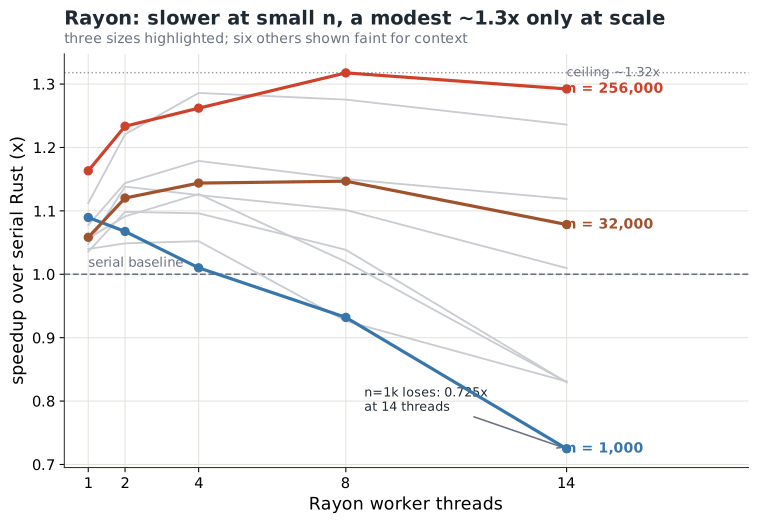
It told me the same loop runs barely faster on 14 cores than on one. Peak speedup climbs with n and plateaus near 1.3x, reaching 1.318x at n=256k and 1.286x at n=64k. At the heaviest workload it’s concrete: 256k/32/k=32 finishes in 16.23 s parallel against 20.76 s serial, about 1.28x. And at small n the threads turn harmful: n=1k peaks at 1.09x with a single worker and falls to 0.725x at 14 threads, a 28% penalty for spinning up all the cores.
Two things hold the gain near 1.3x. The elbow sweep fits k = 1..K, so most fits are small-k with little arithmetic per point, too little to amortize Rayon’s split/join overhead. And the data is an array of structs (Vec<DataPoint>, each point owning a heap-allocated Vec<f64>), so the inner loop pointer-chases and goes memory-bandwidth-bound: a handful of cores saturate the bus, and the rest only add coordination cost. This is why parallel Rust’s grid-wide median wall time (0.197 s) barely edges serial (0.201 s). Across most of the grid the threads add nothing, and on the smallest cells they cost. The 5.1x-vs-Python paired figure is mostly the serial 4.5x with the modest large-n thread gain riding on top.
None of this is about Python’s GIL, the usual scapegoat. NumPy releases the GIL inside its C loops, which is exactly why BLAS-backed calls can use multiple cores. The pure-Python baseline stays on one core simply because a serial Lloyd loop never asks for more. The GIL is the wall when you point threading at CPU-bound Python code, and that is not what is happening in any of these four ways. (The benchmarks page walks the thread-scaling curves in more depth.)
The memory lens
Switch the lens from time to space and the same four implementations re-rank in a way that, for once, never flips with size. Median sampled peak RSS per 1,000 rows: serial Rust 0.61 MB, parallel Rust 0.73 MB, NumPy 7.41 MB, scikit-learn 12.63 MB. That puts serial Rust about 12x leaner than NumPy (7.41/0.61) and 21x leaner than scikit-learn (12.63/0.61). Parallel Rust carries a small premium for per-thread bookkeeping but stays in the same league. Unlike the speed gap, no size flips this ranking.
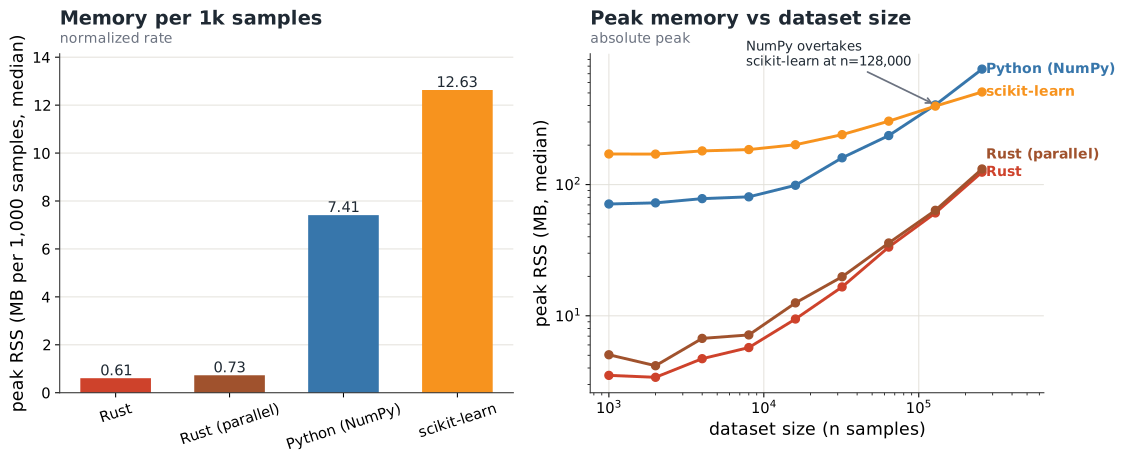
The concrete bill shows up in the heaviest workload: at 256k×32, k=32, scikit-learn peaks at 795 MB and NumPy at 924 MB, while both Rust builds sit near 190 MB (190 parallel, 194 serial). Rust never builds the $n \times k$ distance matrix at all: its assignment step walks each point against the centroids holding only a running nearest-index, so peak memory tracks the data itself rather than a float64 block that reallocates every iteration.
One correction to my earlier write-up, where I’d guessed wrong about the cause. The Rust memory win has nothing to do with a tight cache-local matrix. The layout is an array of structs with a heap Vec<f64> and a string id per point, which is anything but cache-friendly. The advantage comes entirely from never allocating the distance matrix. A flat contiguous Vec<f64> is the optimization I left on the table, and it would help the parallel story and the large-n slope too.
The accuracy lens
Switch the lens again, from resources to results, and the matched-init thread finally pays off the debt it has been carrying since the setup. The rerun changes a conclusion here, and it is the most important correction in the post. In my first pass the hand-rolled implementations used random init while scikit-learn used its default ten restarts, and Rust posted the worst clusterings of the four (ARI 0.66 against scikit-learn’s 1.0). I briefly believed the rewrite traded accuracy for speed. It didn’t. The gap was the experiment design.
With every implementation on the same k-means++ init, the median ARI is 1.00 for all four. Serial and parallel Rust are bit-identical in quality: the same seed reaches the same answer whether one thread or fourteen does the arithmetic. The means barely separate (scikit-learn 0.9988, Python 0.9802, Rust 0.9742), and internal metrics agree (silhouette 0.93/0.92/0.92; Davies-Bouldin 0.10/0.18/0.19).
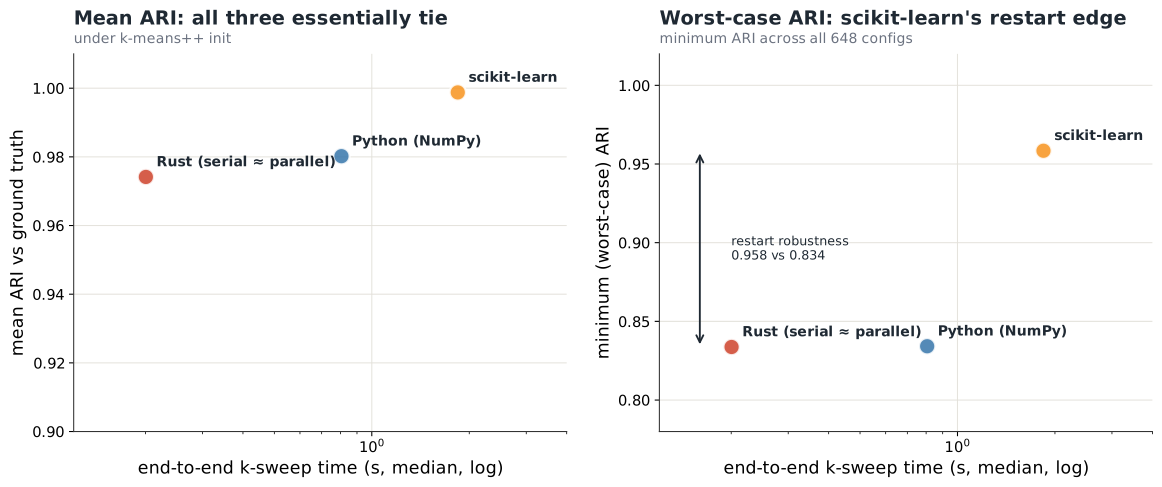
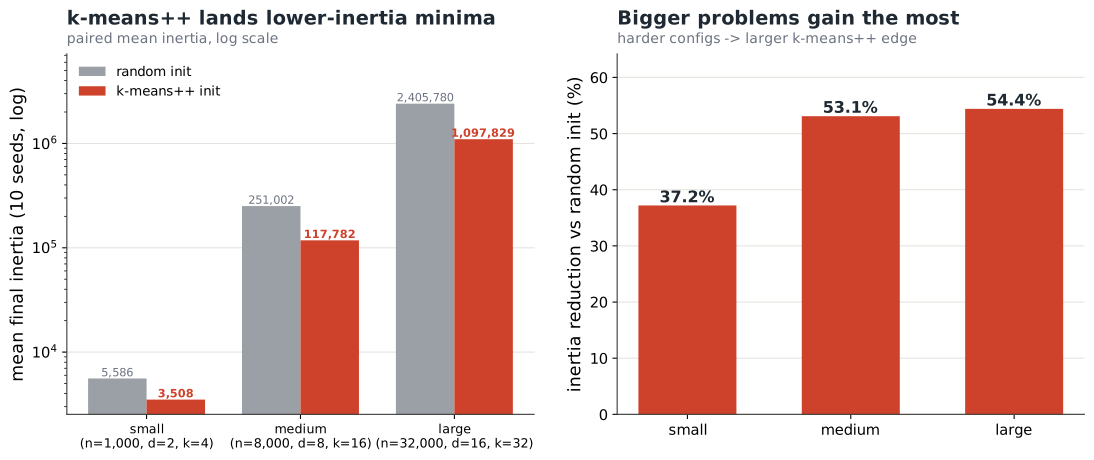
scikit-learn keeps its one edge in that worst case through its greedy k-means++ variant, which tries several candidate seeds at each step and keeps the best. (Convergence tolerance and empty-cluster handling differ too, so the gap isn’t all seeding.) But the seeding is also where the cheapest win in the whole project lives, and it is available to all four. k-means++, due to Arthur and Vassilvitskii in 2007, changes only the seeding, not a line of the loop. Rather than dropping k seeds uniformly at random, let $D(x)$ be the distance from $x$ to the nearest seed already chosen; then pick each new seed with probability $p(x)$ proportional to $D(x)^2$:
\[p(x) \propto D(x)^2\]Far-away regions get seeded, clumps don’t, and a single start usually lands near a good basin (the paper proves an $O(\log k)$ bound on expected cost). In a standalone pure-Python ablation with 10 seeds per config, switching random init to k-means++ cut final inertia by 37% to 54%, and the benefit grows with k and dimension.
The lens no rewrite changes
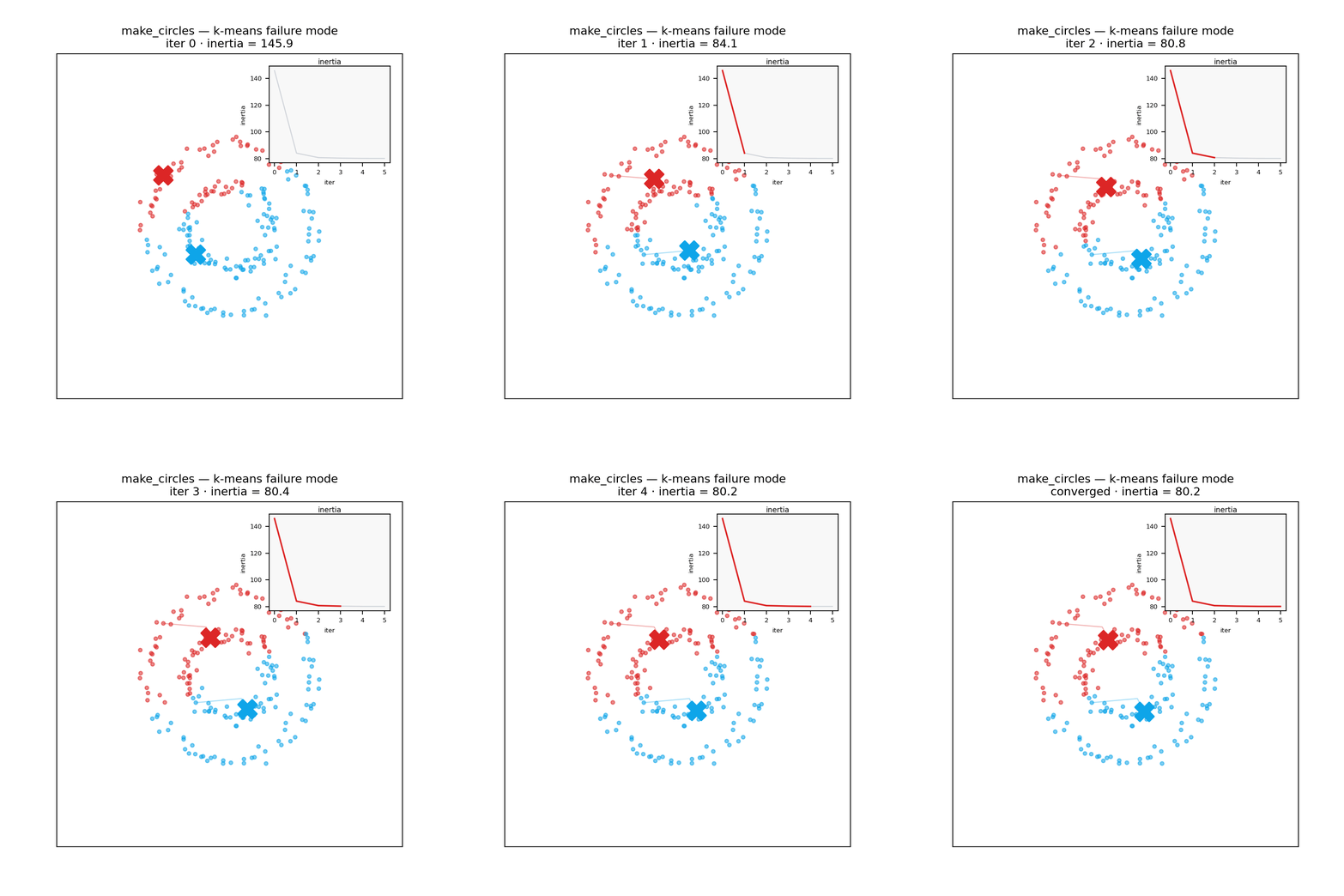
There is one property of the substrate that survives every diff, because it lives in the model and not the implementation. k-means carves space into convex Voronoi cells around its centroids, so it assumes roughly round, similarly sized clusters. Hand it two concentric rings and all four ways, in every language, fail identically.
What the four ways add up to
Walk the diffs back the way you came, and the decision falls out cleanly. If your bottleneck is a NumPy k-means at small to medium n, the reflex is vindicated: hand-rolled serial Rust runs about 4.5x faster at the median, uses an order of magnitude less memory, and that memory edge doesn’t erode as the data grows. Push to large n and large k and tuned linear algebra takes over: rewrite to beat your interpreter, not BLAS, and if you need that corner too, reach for a flat-matrix, GEMM-backed Rust before reaching for more threads. Parallel Rust was the smallest lever in the whole project (1.32x at best, a penalty at small n). The biggest lever was free and lived in none of the engines: matching the initialization closed the accuracy gap entirely and cut inertia by up to half.
| Situation | Reach for |
|---|---|
| Small/medium NumPy k-means bottleneck | Serial Rust: ~4.5x faster, ~12x leaner |
| Very large n × k | scikit-learn, or a BLAS-backed flat-matrix Rust |
| Accuracy matters most | k-means++ on any of the four; it closed the gap for free |
| Memory is the constraint | Rust (serial or parallel), at every size |
| Hoping threads will rescue it | Measure granularity first; Rayon bought 1.32x here and hurt at small n |
The one result I would not bet on transferring is that crossover corner: the exponents above are my M4 Max’s cache hierarchy and BLAS build as much as the algorithm’s, so the exact n where scikit-learn overtakes naive Rust will land somewhere else on your machine. Everything else, the memory ranking, the matched-init tie, the thread plateau, came out of one computation expressed four ways. All four implementations, the sweep harness, and the full Plotly dashboards are in the repo. Go race them yourself.
Race WASM vs JS in the live demo Read the project write-up Browse the code